 Whatsapp



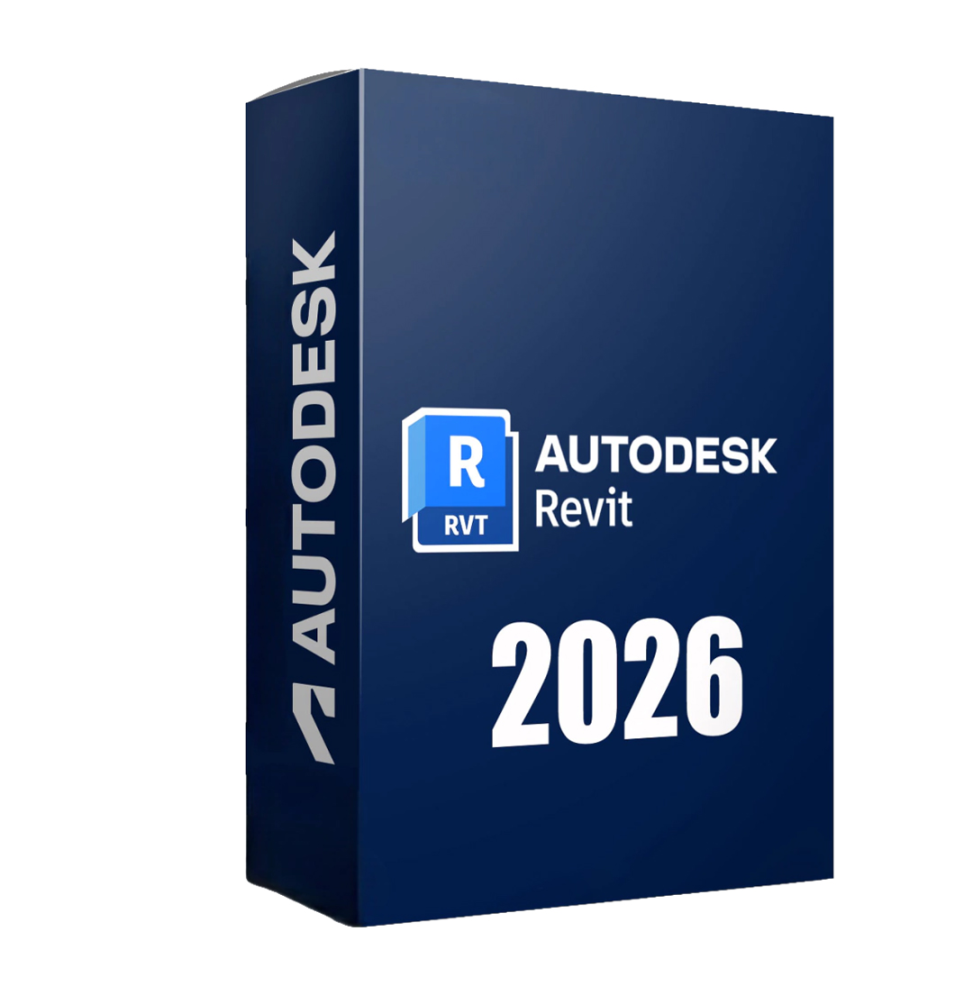
AUTODESK REVIT 2026
 Immediate digital delivery
Original license
Satisfaction guaranteed or refunded within 30 days
Simple activation
Installation guide included
24/7 support including WhatsApp
Reusable in case of formatting
Multilingual
Updates included where applicable
AUTODESK REVIT 2026
Autodesk Revit 2026 is a professional BIM platform designed for the integrated design of buildings and infrastructure, used by architects, structural engineers, MEP designers, and construction professionals to develop intelligent models, coordinate different disciplines, and produce consistent technical documentation from a single digital model. Revit allows you to model in 3D with parametric logic and automatically update views, prospects, sections, tables and abaci when the project is modified, improving control, accuracy and collaboration between teams.
Who it is suitable for
Autodesk Revit 2026 is particularly suitable for:
- architects and architectural design studios
- structural engineers
- MEP designers for mechanical, electrical and plumbing systems
- engineering companies and general contractors
- BIM managers, BIM coordinators and multidisciplinary teams
- companies requiring coordination between design, documentation and construction
Main Features
Parametric BIM design
Revit 2026 allows you to create walls, doors, windows, floors, roofs, structures and plant systems within an open and data-rich parametric environment. Objects are not simple graphic elements, but intelligent components with properties, relationships and constraints that allow to maintain consistency between model and documentation.
Multidisciplinary 3D modeling
The software supports the coordinated design of architecture, structures and systems in the same BIM ecosystem. Revit provides multidisciplinary tools to reduce rework and improve collaboration between departments and consultants.
Automatic documentation
From a single model it is possible to generate project boards, views, sections, prospects, details, revisions and abaci. Autodesk indicates that Revit allows you to create project sheets, add drawings and tables, customize cartouches and manage revisions centrally.
Annotations, details and tables
Tools for tags, dimensions, 2D and 3D annotations, visibility settings, graphic filters and overrides are included, useful for precisely communicating the design intent and for producing neat and readable executive elaborations.
Abaci, data and information management
Revit allows you to use tables and abaci to capture, filter, sort, view and share project data. This aspect is fundamental for calculations, component control, quantity verification and BIM information management.
Worksharing and collaboration
The software supports shared work on a central model, with saving, synchronization, review and continuous updating of the project in collaborative environments. Autodesk also highlights collaboration on files hosted in Autodesk Docs and the support of Revit cloud worksharing and BIM Collaborate Pro for distributed teams.
Interoperability
Revit imports, exports and links commonly used BIM and CAD formats, including IFC, 3DM, SKP, OBJ and STEP. It also supports the import and export of 2D boards and interoperability with Navisworks coordination models.
Visualization and rendering
Revit 2026 integrates the direct start of Twinmotion from Revit, with synchronization of project data to generate photorealistic images, scenes and animations. This is useful for presentations, project reviews and communication with the client.
Phases, reviews and project control
The software includes tools to define the phases of the project, including demolitions and renovations, apply phase filters to views and abaci and track changes after the issuance of the boards.
Specific tools for architecture, structures and MEP
Revit offers functions dedicated to the main AEC areas:
- Architecture: parametric components, documentation, annotations, view management and BIM coordination.
- Structures: structural modeling, 3D reinforcements, parametric steel connections, bidirectional link with analysis, Dynamo tools for structural engineering and interoperability with Advance Steel.
- MEP: design and documentation of HVAC systems, electrical and hydraulic systems, analysis of MEP systems, modeling of LOD 400 manufacturing components and conversion from design to fabrication.
- Construction: construction-oriented modeling, manipulation of wall layers and concrete pours, preparation of elaborations and coordination with Navisworks.
New features and improvements in the 2026 release
Among the official new features of the 2026 version, Autodesk reports improvements to the coordination model management, quick access to analytical model automation, improvements to custom steel connections, new possibilities for positioning views on sheets and improvements to sheet list schedules and the organization of panel schedules in the project browser. Autodesk also describes the 2026 release as focused on improvements in modeling capabilities, coordination workflows and documentation processes.
What is included
In Autodesk Revit 2026, the main tools are included for:
- 3D parametric BIM modeling
- architectural design
- structural design and reinforcement detail
- MEP modeling and documentation
- boards, sections, prospects, abaci and reviews
- worksharing and collaboration on shared model
- interoperability with common BIM/CAD formats
- Dynamo and development tools/API
- direct start of Twinmotion from Revit
- link with analysis, coordination and fabrication flows in the AEC field
Operating system compatibility
Autodesk indicates for Revit 2026 the support for the following operating systems:
- Microsoft Windows 11 64 bit
- Microsoft Windows 10 64 bit version 1809 or later
In general, Revit is supported on Windows and does not have a native version for macOS or Linux.
Hardware requirements
According to Autodesk, the system requirements of Revit 2026 are articulated by usage range. In summary, for professional use, good level components are recommended, especially on medium-large projects. The main points reported by Autodesk include:
- Operating system: Windows 10/11 64 bit supported
- CPU: multi-core processor; Autodesk publishes differentiated requirements based on project complexity
- RAM memory: minimum configurations and higher based on the size of the models
- Disk space: local installation with adequate free space
- Graphics card: GPU compatible with graphic acceleration and adequate drivers
- Display: minimum standard resolution, with clear benefit on high resolution monitors
- Internet connection: necessary for installation of components, updates, cloud services and collaboration
For a commercial product card, you can present the recommended requirements in a practical form as follows:
- Recommended processor: High performance multi-core CPU
- Recommended RAM: at least 16 GB, preferably 32 GB for complex models
- Recommended storage: SSD
- Recommended graphics card: Dedicated GPU compatible with hardware acceleration
- Recommended monitor: Full HD or higher
This formulation remains consistent with the Autodesk indication that distinguishes between entry-level configurations and better performances for more complex projects.
Prerequisites and software environment
Autodesk also publishes a page dedicated to the prerequisites of Revit 2026, which specifies the components normally installed together with the program when necessary. This confirms that the software relies on an updated Windows environment and support components installed during setup.
Why choose Autodesk Revit 2026
Autodesk Revit 2026 is an ideal solution for those who want to develop BIM projects in a structured, coordinated and professional way. Its main advantage is the ability to combine parametric modeling, automatic documentation, multidisciplinary collaboration and information management within a single operating environment. Thanks to the dedicated tools for architecture, structures, MEP and construction, it represents a complete platform for the entire project life cycle, from the conceptual phase to the documentation and executive coordination.
Short text for product card
Autodesk Revit 2026 is a professional BIM software for the integrated design of architecture, structures and systems. It allows you to create intelligent 3D parametric models, automatically generate boards, sections, prospects and abaci, and coordinate the work of multidisciplinary teams in a single environment. Thanks to the dedicated tools for documentation, worksharing, interoperability and cloud collaboration, Revit 2026 is particularly suitable for architectural studios, engineering companies, MEP designers, BIM managers and companies that require high precision, information consistency and control of the entire project process. It supports Windows 10 and 11 64 bit and is designed for professional workstations with multi-core CPU, abundant RAM, SSD and dedicated graphics card.

Specific References
- EAN13
- 6247317810807
16 other products in the same category:

Immediate digital delivery
Original license
Satisfaction guaranteed or refunded within 30 days
Simple activation
Installation guide included
24/7 support including WhatsApp
Reusable in case of formatting
Multilingual
Updates included where applicable