 Whatsapp



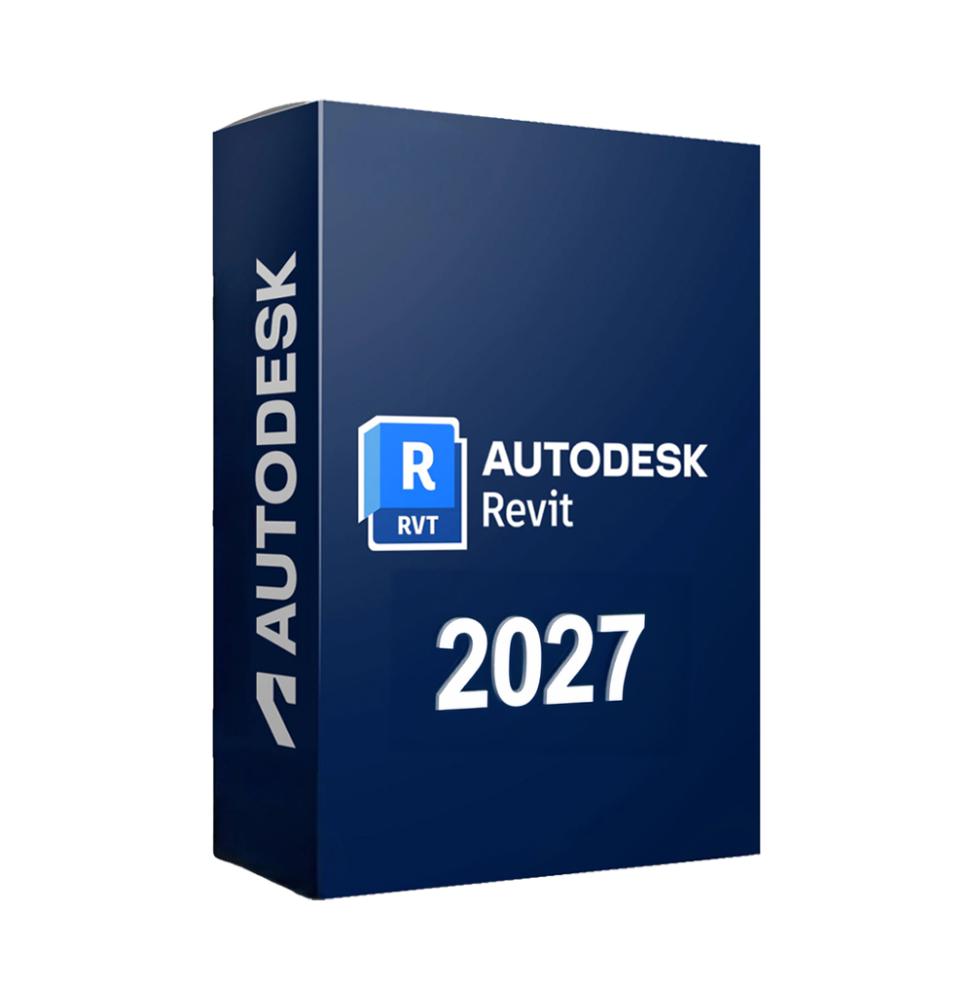
AUTODESK REVIT 2027
 Immediate digital delivery
Original license
Satisfaction guaranteed or refunded within 30 days
Simple activation
Installation guide included
24/7 support including WhatsApp
Reusable in case of formatting
Multilingual
Updates included where applicable
AUTODESK REVIT 2027
Autodesk Revit 2027 is a new generation professional BIM platform designed for parametric modeling, technical documentation, and multidisciplinary coordination in the AEC field. It is intended for architecture, structures, and installations, and allows the development of a single intelligent information model from which views, sections, prospects, tables, abacuses, and revisions are automatically derived. In this release, Autodesk particularly focuses on productivity, cloud integration, automation, and more connected workflows, introducing new features related to Autodesk AI and a closer connection with the Forma ecosystem.
Who it is suitable for
Autodesk Revit 2027 is particularly suitable for:
- Architectural firms working in a BIM environment
- Structural engineers and structural design companies
- MEP designers for mechanical, electrical, and plumbing installations
- BIM managers, BIM coordinators, and multidisciplinary teams
- Companies, general contractors, and professionals who need coordination between design, documentation, and construction
- Technical offices that want to centralize project data, views, and computations in a single operating environment
Main Features
Parametric BIM modeling
Revit 2027 allows you to model buildings and construction systems in 3D with intelligent and parametric objects. Walls, floors, roofs, doors, windows, families, structures, and plant components are not just graphic elements, but objects containing information, rules, and relationships. This allows the project to be kept consistent in all its parts and to automatically update the model and documentation when a change is made.
Automatic technical documentation
One of the main strengths of Revit is the ability to generate technical documentation directly from the model. The 2027 version continues to provide advanced tools to produce floor plans, elevations, sections, details, tables, and abacuses in a coordinated way. When the project changes, the documentation updates consistently, reducing errors and revision times.
Multidisciplinary coordination
Revit 2027 is designed to promote joint work between architecture, structure, and facilities in the same ecosystem. This BIM setup helps to improve coordination between disciplines, identify problems before the construction phase, and maintain a single, reliable database throughout the project cycle.
Cloud collaboration and connected workflows
The 2027 release strengthens integration with the Autodesk cloud and distributed collaboration flows. Autodesk describes Revit 2027 as a "more connected" version, with improvements that help teams synchronize data, coordinate more quickly, and better connect desktop and cloud platforms. It is also indicated as the first desktop client to become a Forma Connected Client, expanding workflows between BIM modeling and cloud analysis and preliminary design tools.
Autodesk Assistant and AI functions
One of the most obvious new features of Revit 2027 is the introduction of Autodesk Assistant in technical preview. Autodesk explains that this feature brings artificial intelligence directly into the work environment, allowing interaction with the software in natural language to get help, operational instructions, and support in some modeling and documentation actions. This is a significant evolution for those who want to speed up recurring operations and reduce the time spent in searching for commands and procedures.
User interface improvements
Revit 2027 also introduces updates to the interface to align more with the most recent Autodesk experience. Autodesk notes the update of several windows and dialogs, in addition to support for Light and Dark themes, offering a more modern, readable, and consistent work environment with other platform products.
Modeling accuracy and operational improvements
Autodesk indicates for the 2027 version a focus on modeling precision, production efficiency, and improved coordination processes. Among the reported updates are integrations with Issues, workflows linked to Forma, improvements in documentation capabilities, and greater operational fluidity in daily activities that absorb time in complex projects.
Included content and resources
The installation of Revit 2027 includes the necessary core content for the correct operation of the software, including project templates, generic family templates, lookup tables, and basic content required to start the program and work with projects and families. Autodesk specifies that this content is an integral part of the installation.
What is included
From a functional point of view, Autodesk Revit 2027 includes:
- BIM tools for 3D parametric modeling
- Integrated environment for architecture, structures, and MEP
- Automatic generation of views, sections, prospects, tables, and abacuses
- Parametric families and project templates
- Documentation and review tools
- Worksharing and collaboration in connected environments
- Integration with Autodesk Assistant in tech preview
- Integration with the Forma ecosystem and connected cloud workflows
- Interface updates and Light/Dark themes
- Basic installation content for projects and families
Operating system compatibility
According to Autodesk, the system requirements of Revit 2027 support:
- 64-bit Windows 11
- 64-bit Windows 10
Revit therefore remains a software oriented to the Windows environment and is not available in a native version for macOS or Linux.
Hardware Requirements
Autodesk indicates for Revit 2027, as a base, a Intel or AMD processor with a base frequency of at least 2 GHz, recommending a higher single-core frequency for better performance. Autodesk then publishes detailed requirements for different usage scenarios, but for a commercial product card it is correct to present the recommended requirements in a clear and practical form.
Recommended configuration for smooth operation
- Processor: High clock multi-core Intel or AMD; better to favor high single-core performance
- RAM: At least 16 GB, recommended 32 GB for complex models
- Storage: SSD recommended for installation, cache and project files
- Graphics card: Dedicated GPU compatible with hardware acceleration
- Monitor: Full HD resolution or higher, preferably high to better manage views, tables, and multiple windows
- Internet Connection: Necessary for activation, updates, cloud services, and collaborative workflows
Why choose Autodesk Revit 2027
Autodesk Revit 2027 is a particularly valid choice for those who want a complete, modern BIM environment truly oriented to collaboration. The software combines parametric modeling, automatic documentation, discipline coordination, and cloud integration into a single platform. The 2027 release adds a further level of efficiency thanks to Autodesk Assistant, connected workflows with Forma, and interface improvements, making it even more suitable for studios and companies that want to reduce operating times and increase project control.
Conclusion
Autodesk Revit 2027 is an advanced BIM platform for the integrated design of buildings and construction systems, ideal for those operating in the fields of architecture, structures, and installations. It allows you to create intelligent 3D models, automate technical documentation, improve multidisciplinary coordination, and work in increasingly connected cloud environments. Thanks to the new AI functions, integration with Forma, interface improvements, and the solid parametric approach, it represents a complete solution for professional studios, engineering companies, BIM teams, and companies that require precision, productivity, and digital continuity throughout the design process.

Specific References
- EAN13
- 1326773602609
16 other products in the same category:


Immediate digital delivery
Original license
Satisfaction guaranteed or refunded within 30 days
Simple activation
Installation guide included
24/7 support including WhatsApp
Reusable in case of formatting
Multilingual
Updates included where applicable